Friday, 7 February 2014

THE SUM OF THE PARTS………….

The very best artistic and literary works have at their heart an idea and composition.
We can all write and draw; some of us can even write and draw very well. But without a compelling idea and without a highly developed sense of composition (ie: how all the bits are fitted together to make a whole) we will not join the Vermeers or Smarts or the Rushdies of this world and achieve greatness.
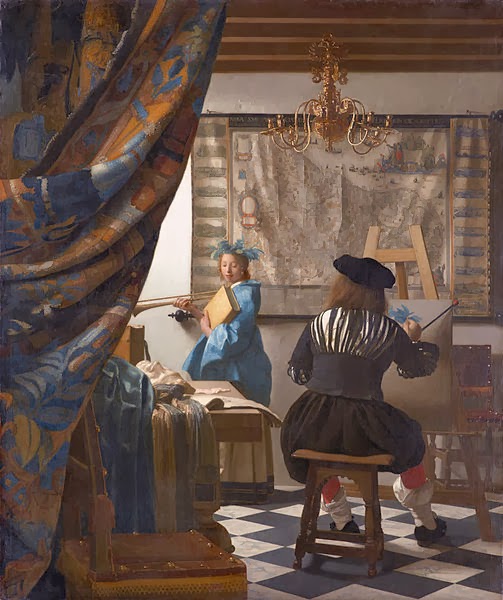
                                                                                                                 The Art of Painting by Jan Vermeer

Van Gogh wrote of the Dutch masters

And there is the story of Jeffrey Smart struggling with the composition for a work he was painting only to find his struggle over when a wood shaving from refurbishments going on in his house floated down and landed on the unfinished work adhering to the wet oil paint on the canvas. He turned the wood shaving into a seagull and that was the piece needed to make the composition complete. It became one of his best known works.

The Bus Stop, Jeffery Smart
And what is the composition of medicine? Surely not what is represented in this poster.
The thing that separates writers who produce one good work from those who produce good works over and over again is that the former compose well by accident whereas the consistently good writer knows how to do it over and over again. And so it is with music.


Writing in 2005, Litaker et al (1) touch on what I consider might be something like composition in healthcare:

“Although health is influenced by an individual’s characteristics and choices, accumulating evidence suggests that contextual attributes may influence a variety of health outcomes.”

So the way in which we assemble all the bits and pieces around the patient may influence outcomes.

In art, ‘The artist determines what the center of interest of the art work will be, and composes the elements accordingly. The gaze of the viewer will then tend to linger over these points of interest, elements are arranged with consideration of several factors …… into a harmonious whole which works together to produce the desired statement – a phenomenon commonly referred to as unity.’

So too does the clinician having recognised the patient as the ‘…center of interestcompose the elements accordingly…’. She or he will take into consideration several factors and work them into a harmonious whole which will then lead to diagnosis and a treatment regime.

If we then move from the individual, the patient, to the collective of patients and think about composition in the healthcare system, the analogy still stands up. Writing in the BMJ with some foresight in 1962, former Chief Medical Officer of the UK Ministry of Health Sir John Charles said (2):

It is my submission that in the operations of our National Health Service, and those other services concerned with the public health, whether administered by the Ministry of Health itself or by other Departments of Government, we have a series of undertakings, symbiotic at least, if not so completely co-ordinated as they might be, which contribute to the social context of our health.’

He went on……..

‘(a) The treatment of the patient as the “whole man" and not merely as the carrier and example of a pathological manifestation.

(b) The recognition of him as a member of a family-and the consideration of the effects of his illness upon the family.

 (c) The evocation of the communal machinery, whether operating through the local health department or otherwise, which will assist him and the family in whatever way help or guidance may be required.

(d) The relevance of occupation to the patient's illness.

(e) The place of psychological factors -- the stresses, strains, and suffocating frustrations of modern life and modes of living-in the causation and continuance of the patient’s condition.’

Halfon et al writing in the Healthcare Quarterly in 2010 (3) also talks about the importance of considering all the bits and pieces and (more importantly) how they need to be skilfully put together when faced with healthcare challenges across populations:

“There is no simple biological reason why the risk of pregnancy-related death in Sweden is one in 17,400 while it is one in eight in Afghanistan; why the life expectancy at birth of men in the Calton region of Glasgow is 54 years, 28 years lower than that of men in Lenzie, just a few kilometres away.”
These striking disparities “reflect avoidable and unnecessary suffering,” a California-based team of healthcare researchers say. Social environments clearly matter for health. Yet these critical factors – the social determinants of health – have been “conspicuously absent” from the recent US healthcare debates.
But the question remains: if health is individual and biological, how do social determinants get “into the body”? How, exactly, does my social context affect my health?’’
The University Of Michigan Department Of Health certainly gives a nod to the importance of composition in seeking to improve healthcare quality. Its course in

Social, Cultural and Community Context of Healthcare talks about how

‘Residents will learn how to recognize the diverse factors that influence the health of individuals in the community. They will be able to identify social, cultural, familial, psychological, economic, environmental, legal, political and spiritual factors that impact health care and health care delivery. They will respond to the social context created by these factors by planning and advocating the appropriate course of action at both the individual and community level. They will develop zero tolerance for stereotypic language, racism, sexism, ageism, and aspersions to individuals or groups based on ethnic, religious and sexual preference or lifestyle choices. They will avoid identifying individuals by the name of their disease. They will understand all the reasons behind non-adherence and methods to mitigate it. They will learn the benefits of being an advocate for better health for patients in the community and understand the resources available in the community to provide ethnicity- and gender-sensitive and culturally-competent healthcare’.

So, in short, it is important to understand how best to assemble all the elements of healthcare both for the individual and for the community to achieve the most pleasing results.

‘A work of art is said to be aesthetically pleasing to the eye if the elements within the work are arranged in a balanced compositional way. However, there are artists such as Salvador Dalí whose sole aim is to disrupt traditional composition and challenge the viewer to rethink balance and design elements within art works’.(4)
Run your eye back up to the Vermeer with which I started this BLOG, then down to the Dali below and I will leave you to decide what achieves the most pleasing result.

                                                                         Still Life Moving Fast, Salvador Dali: 

Peter Carter
Chief Executive Officer
ISQua
February 2014


(1)     Litaker, David MD, PhD*†; Koroukian, Siran M. PhD†; Love, Thomas E. PhD†‡
         Medical Care June 2005 – Volume 43 – Issue 6 – pp531-540
(2)     Sir John Charles: BRITISH MEDICAL JOURNAL, LONDON SATURDAY DECEMBER 22 1962
(3)     Halfon, Neal, Kandyce Larson, and Shirley Russ. 2010. “Why social determinants?”   Healthcare Quarterly 14 (Special issue, October): 9-20.
(4)     Wikipedia


Friday, 17 January 2014

AN END TO SILOS…

Australia is a predominantly flat country. There is a mountain range running for about 800 k from south to north and a couple of hundred k inland from the south east coast. But that’s about it for elevation. West of that range are sweeping plains that go on forever.

On long drives across these plains one comes across silos from time to time. They are the only things with any height in the landscape and they sit as sentinels for the few inhabitants of the Australian outback. They are scattered and unconnected.


I had the same experience travelling by train from Vancouver to Edmonton. Once I cleared the Rockies the silos were all that interrupted the horizon. It must have been this that Denise Deveau had in mind when she wrote about the silos of Canada’s health care system in the September 17 edition of the Financial Post. Denise spoke of funding and systemic cultural silos and a lack of integrated technology; of multiple governance models and multiple jurisdictions all managing their own budgets; and different ministries all operating at their own pace. She described the silo mentality as systemic - from technology to treatment to the way healthcare professionals and providers are paid. Denise observed that the traditional forms of payment reinforce the silo mentality and encourage professional territoriality.

Such observations are not new and they are not unique to Canada.

ISQua’s Innovation and Systems Change Committee has been considering the limitations to this traditional approach to healthcare delivery and pondering alternatives to it.

The outcome of those ponderings is a paper commissioned by the Committee and prepared by Hilary Dunne entitled Capturing the Consequences of Adopting the Paradigm Shift of the Patient’s Journey.
Hilary found that the patient journey is typically regarded today as a paradigm that includes all aspects of the patient care journey from the time the patient notices symptoms of ill health to the point of better health or the need for palliative care.

The paper formed the basis of an interactive workshop at the Edinburgh conference at which the following questions were addressed:
  • How can we get innovation so that better models of care can emerge?
  • What emerging issues are likely to impact on the patient journey?
  • What does an improved model for the patient journey look like?

The ISQua innovations ‘brains trust’ has identified the following as some of the matters to be considered when reconceptualising the patient journey:
  • Digital health technology;
  • The patient as an expert on her/his own condition;
  • The availability of a ‘navigator’ to navigate the patient through the system and as a conduit for good practice;
  • The relationships of patient/provider and provider/provider;
  • The need for common definitions.

One suggested approach to achieving a seamless patient experience I came across in researching for this BLOG spoke of ‘building bridges to connect silos’.  For me this misses the point of rethinking how we move from episodic to continuous care. Simply connecting silos does not achieve the new paradigm.

In order to bring the best minds to bear on the need to rethink how we improve the patient experience from diagnosis to recovery or palliative care,  ISQua will host an invited seminar in 2015 on ‘2025’s vision of benefits and risks of changing healthcare – Reconsidering evaluation of healthcare systems in Western Countries through the prism of a system approach.

So, here is hoping that in 2030, after all this good work is done, I will not notice silos as I travel across the healthcare plains of the world.

Peter Carter
Chief Executive Officer
ISQua
January 2014

Monday, 2 December 2013

TIPPING POINT?


Here is today’s question:

What is the difference between a PANDA serenely sitting and eating shoots and leaves,

and

A PANDA having a meal, firing a gun and departing?

The answer……….  a comma.

Here is what I mean.

A Panda eats shoots and leaves.

A Panda eats, shoots and leaves.

The rules of language and punctuation are complex; get them even a little wrong and, well anything can happen, like causing a PANDA to act completely out of character. As Lynne Truss says:

 “We have a language that is full of ambiguities; we have a way of expressing ourselves that is often complex and elusive, poetic and modulated; all our thoughts can be rendered with absolute clarity if we bother to put the right dots and squiggles between the words in the right places. Proper punctuation is both the sign and the cause of clear thinking. If it goes, the degree of intellectual impoverishment we face is unimaginable.” 
― 
Lynne TrussEats, Shoots & Leaves: The Zero Tolerance Approach to Punctuation

But these rules of language and punctuation can also be a bit tiresome. Winston Churchill, himself a Nobel Laureate in literature, demonstrated how silly was the rule about never ending a sentence with a preposition with this: ‘this is something up with which I will not put’.

Dealing with the language we have is bad enough but having to incorporate new expressions into the language AND to use them as intended by who ever invented them is a nightmare.

Take ‘The Tipping Point’ for example. In his No.1 Best Seller of that name Malcolm Gladwell used this expression when talking about why a particular trend will “tip” into wide-scale popularity while another will ‘splutter and fade into oblivion’. The subtitle to Gladwell’s book is ‘how little things can make a big difference’. Sadly the term ‘tipping point’ is now used by just about everyone to refer to just about any change. So it has lost its potency and uniqueness.

Can all things, including health related issues, rise or fall as a result of tipping points? If so they need to satisfy Gladwell’s three key factors that each play a role in determining whether a particular trend will “tip” into wide-scale popularity’' being, the Law of the Few, the Stickiness Factor, and the Power of Context.

The Law of the Few. ‘….many trends are ushered into popularity by small groups of individuals who can be classified as Connectors, Mavens, and Salesmen.

Connectors are individuals who have ties in many different realms and act as conduits between them, helping to engender connections, relationships, and “cross-fertilization” that otherwise might not have ever occurred. Mavens are people who have a strong compulsion to help other consumers by helping them make informed decisions. Salesmen are people whose unusual charisma allows them to be extremely persuasive in inducing others’ buying decisions and behaviours.’

The Stickiness Factor: ‘ This refers to a unique quality that compels a phenomenon to “stick” in the minds of the public and influence their future behaviour’.

The Power of Context: ‘ If the environment or historical moment in which a trend is introduced is not right, it is not as likely that the tipping point will be attained.’

Let me attempt then to apply Gladwell’s Tipping Point theory, first to one of the case studies that I will be using in a forthcoming webinar I am delivering for the ISQua Fellowship Programme and second to the advent and aftermath of the HIV AIDS epidemic. I am not sure this will work but it should be interesting. I suspect that we may be thinking catalyst than tipping point; let’s see.

Case Study                 

A surgeon is practising beyond his professional knowledge and skills and beyond his hospital’s technical capacity.

After this has been going on for some time and expressions of concern to the hospital and authorities by one assistant and the family of an injured patient go unheeded, the assistant (‘whistleblower’) goes public. The popular Press gets hold of it and, predictably it becomes front page news; and it does not go away.

Bureaucracy finally acts (perhaps overreacts).

Several inquiries ensue and numerous vetting and regulatory practices are changed.

Widespread culture change becomes evident within the period of just 12 months whereby it is now natural for colleagues, patients, families to report their suspicions about less than optimal practices and outcomes.

HIV AIDS
Let us work backwards. A person deliberately or even knowingly infecting a partner in many countries today is a criminal offence leading to imprisonment. Doctors in many countries today are now required by law to inform a partner of a HIV positive patient of the positive status of his/her partner.
How is it that we have reached this point when we were initially in denial about HIV AIDS, then accepted it existed but seemed powerless against it; rather like the rabbit caught in headlights. (I digress, but is not history repeating itself with climate change?) 
Does this fit our criteria for a Tipping Point?
Let us consider the Australian response to the AIDS ‘epidemic’.
The following extract is taken from Wikipedia.
The Australian health policy response to HIV/AIDS has been characterised as emerging from the grassroots rather than top-down, and as involving a high degree of partnership between government and non-government stakeholders. The capacity of these groups to respond early and effectively was instrumental in lowering infection rates before government-funded prevention programs were operational. The response of both governments and NGOs was also based on recognition that social action would be central to controlling the disease epidemic.
In 1987, a famous advertising program was launched, including television advertisements that featured the grim reaper rolling a ten-pin bowling ball toward a group of people standing in the place of the pins. These advertisements garnered a lot of attention: controversial when released, and continuing to be regarded as effective as well as pioneering television advertising.
The willingness of the Australian government to use mainstream media to deliver a blunt message through advertising was credited as contributing to Australia's success in managing HIV. 
 Australian Governments began in the mid-1980s to pilot or support programs involving needle exchange for intravenous drug users. These remain occasionally controversial, but are reported to have been crucial in keeping the incidence of the disease low, as well as being extremely cost-effective.
Australian governments have made it illegal to discriminate against a person on the grounds of their health status, including having HIV/AIDS. However HIV positive individuals may still be denied immigration visas on the grounds that their treatment takes up limited resources and is a burden for taxpayers.’
 Does this response tick the three ‘Tipping Point’ boxes; The Law of the Few, The Stickiness Factor and the Power of Context? I would say a resounding YES.
Can we now ask if our surgery case study passes the ‘Tipping Point’ test? I think it does not. Here I believe we have a ‘catalyst’ rather than a Tipping Point. A catalyst is ‘a person or thing that precipitates an event or a change’.
This BLOG is about how change happens rather than about the (mis)use of the English language.
But I have to end it with a delicious quote from ‘Eats, Shoots and Leaves’:
“If you still persist in writing, "Good food at it's best", you deserve to be struck by lightning, hacked up on the spot and buried in an unmarked grave.” 
 
Lynne Truss, Eats, Shoots & Leaves: The Zero Tolerance Approach to Punctuation

NOW, how many of you have gone back over this BLOG looking for the (deliberate?!) errors of punctuation and grammar?

Peter Carter
Chief Executive Officer
ISQua
December 2013

Monday, 4 November 2013

Microcosmographia of Leadership and Management


My friend and mentor Bruce Barraclough gave me a book many years ago (he must have decided I needed help) titled Leadership Secrets of Attila the Hun.(1)


It offers such gems as:

‘Never allow your Huns too many idle moments. These give rise to the beginnings of discontent’

and

A Hun who takes himself too seriously has lost his perspective’

and

‘A King with chieftains who always agree with him reaps the counsel of mediocrity’
And if one is looking for the perennial verita of leadership and management it is hard to go past Cornford’s 1908 booklet: Microcosmographia Academica. I still use it when invited to speak on leadership and management. How can you argue with:

You think you have only to state a reasonable case and people must listen to reason and act upon it at once. It is just this conviction that makes you so unpleasant’. ‘If you want to move (people) you must address your arguments to prejudice and political motive’.

And in a similar vein:

I like you better for your illusions; but it cannot be denied that they prevent you from being effective’
Then, by way of reminding us of the uselessness of endless prevarication and procrastination in committee Cornford asks us:

‘….has it ever occurred to you that nothing is ever done until everyone is convinced that it ought to be done (and by then)…it is …time to do something else’.

MICROCOSMOGRAPHIA
ACADEMICA
BEING A GUIDE FOR THE YOUNG ACADEMIC POLITICIAN
F. M. CORNFORD


Published by Bowes & Bowes Publishers Ltd, Cambridge
First published 1908


ORIGINAL EDITION PRINTED IN CAMBRIDGE BY METCALFE & COMPANY LTD


TO
EDWARD GRANVILLE BROWNE


ADVERTISEMENT
If you are young, do not read this book; it is not fit for you;
If you are old, throw it away; you have nothing to learn from it;
If you are unambitious, light the fire with it; you do not need its guidance.
But, if you are neither less than twenty-five years old, nor more than thirty;
And if you are ambitious withal, and your spirit hankers after academic politics;
Read, and may your soul (if you have a soul) find mercy!


In management we talk a lot about principles and we talk about them as if they are good things. Cornford does not think so:

A principle is a rule of inaction, which states a valid general reason for not doing in any particular case what, to unprincipled instinct, would appear to be right’.

It may appear from what Wess Roberts and R M Cornford say in Attila and Mirocos that they do not have any time for leaders and managers and you might think that in choosing to quote them,- neither do I. This could not be further from the truth. Sarcasm and even, in the case of Cornford, occasional scorn invite us to consider what might be the opposite of what is in the writer’s sights. Read these books through and you find yourself understanding how to be effective in your organisational role – and whether we like it or not most of us have at least one organisational role.

People refer to ‘leadership qualities’ more than they talk about ‘management qualities’ and people refer to ‘management abilities’ more than they talk about ‘leadership abilities’. But each is used in both contexts. Many people believe that leadership cannot be taught and it is generally accepted that management can be. There are countless MBAs around but I have never seen a Master of Leadership….Master of Leadership?what?. and therein lies a clue. Master of Leadership Administration? I don’t think so…Master of Business Leadership..hmmmmm maybe.

In any case both quality leadership and quality management are essential if an organisation is to succeed and it is therefore imperative that we try to help people to become better at leading and managing. And we can. Even if in the more complicated case of leadership, if all we do (and there is doubtless more we can do) is to identify and understand the qualities and attributes of successful leaders and try and emulate them, improvement should follow.

The ISQua Fellowship is a professional development programme for professionals engaged in or interested in healthcare.


Effective leadership and quality management is essential to the delivery of high quality healthcare. We are about to introduce e modules into our Fellowship Programme in generic leadership and management and you might be interested in what we plan to offer. These will be available from 2014 so let us have your thoughts on what we might include.

There will not be too much of Attila or Microcosmographia – but there will be some – such as these, my favourites from Cornford:

The more rules you can invent the less need there will be to waste time puzzling about right and wrong’

and

There is only one argument for doing something; the rest are arguments for doing nothing’.

Tuesday, 24 September 2013

Two Stars and a Cast of Thousands


I spent last weekend proof reading the programme for the forthcoming ISQua Annual International Conference in Edinburgh, Scotland. By the time I reached page 76 I was both exhausted and impressed. The number and quality of the various activities is staggering. Of course I thought I knew what was on offer before I embarked on the proof reading exercise but was unprepared for the sheer volume, diversity and quality of what awaits delegates in just a few short weeks.


There are six plenaries presented by people any of us would cross the world to see on topics ranging from how we communicate to improve the quality movement; to a new approach to managing complexity in healthcare; to improving quality and efficiency through workflow management.

There are 250 presentations of 15 to 90 minutes and 367 posters covering all manner of safety and quality topics. These have been selected from 1300 abstracts submitted in the hope of being chosen to feature. The presentations cover nine themes or tracks, including Patient Safety and Patient Centered Care, Informatics, Education, Low and Middle Income Countries, Population Health, Governance and External Evaluation.
I never cease to be amazed and impressed with the amount of work that goes into providing delegates with a scientifically challenging and enlightening conference programme while at the same time ensuring that ample opportunities are available for networking. Then there is organising the half dozen or so social events, ensuring there is a mix of accommodation options, resourcing the various information points so no delegate question goes unanswered, meeting and greeting, convening around 16 business meetings, securing sponsorship and exhibitors preparing and erecting signage, organising food and beverage and, in the case of Edinburgh ORGANISING KILTS FOR HIRE! And our friends and colleagues in Scotland have been beside us all the way in this.

The stars of this show are of course the speakers and you, the delegates – the cast of thousands - but behind the scene stars are without a doubt our Events Manager Eadin Murphy and Deputy CEO Triona Fortune.


And it is not enough that Eadin and Triona are ‘up to their necks’ in Edinburgh Conference organisation but they are also busy with Brazil 2014, Qatar 2015, Japan 2016 and Europe 2017.

And the considerations range from the reading of 1300 abstracts and assigning them to reviewers for double blind reviews to orchestrating the opening ceremony with its various dignitaries and VIPs and deciding whether the Millennium Clock should be activated during the Welcome Reception at the Edinburgh Museum – and yes, hiring kilts.

So, many thanks to the cast of thousands and special recognition of the two stars of the show.

Peter Carter
Chief Executive Officer
ISQua
September 2013

Thursday, 29 August 2013

DOG BLOG

May I introduce you to Professor Edward T. Creagan. 
Professor Creagan is Professor of Oncology at New York Medical College and a Fellow in Internal Medicine at the Mayo Clinic Graduate School of Medicine


His recent publications include:

Dronca RS, Allred JB, Perez DG, Nevala WK, Lieser EA, Thompson M, Maples WJ, Creagan ET, Pockaj BA, Kaur JS, Moore TD, Marchello BT, Markovic SN.
Am J Clin Oncol. 2013 Jan 24. [Epub ahead of print]

Jatoi A, Allred JB, Suman VJ, Creagan ET, Croghan GA, Amatruda T, Markovic SN.
J Geriatr Oncol. 2012 Oct 1;3(4):307-311. Epub 2012 May 7.

He also wrote a BLOG recently on Pet therapy: How animals help us heal.

Dr Creagan believes in the healing power of pets. He talks of his life changing experience several years ago when a patient he thought he would lose was inspired to fight on by his overwhelming desire to return home to Max, his German Shepherd.

The Mayo Clinic takes the healing power of pets seriously. It has Jack; or to give him his correct title, Dr Jack. He is a 10 year old miniature pinscher. Dr Jack sees around ten patients a day. He is one of the thousands of canine healthcare ‘professionals’ known as ‘assistance dogs’. ‘Sometimes they help a healthcare provider with treatment and sometimes they just spend time with patients. The Health benefits are diverse’ writes Karen Ravn in the Los Angeles Times.

Mayo is world renowned for its scientific rigour and clinical excellence. There is something like 250 areas of research and numerous research projects being undertaken in each research area at any one time. Yet Mayo has Dr Jack. Mayo published a children’s book recently to explain the history of Mayo and what it does. They chose Jack as the vehicle to do this because they believe he exemplifies the Mayo model of care. The book is called ’Dr Jack: The Helping Dog’.

Another book published recently on the subject is ‘Dogs that Changed the World’. It tells the story of Daisy and Tangle, dogs able to sniff out cancer cells, and Delta, a German Shepherd who can sense changes in the blood sugar levels of her young master. And at the Sensory Research Institute at Florida State University in Tallahassee, scientists have trained dogs to detect the odour of skin melanomas and prostate cancer. Researchers are now training dogs to sniff out ovarian cancer.


 ISQua Staff Dogs:  Mr Johnny Angel, Maxie, McGrath, Scamp, Muhtar and Sasha  

Our pets are always therapeutic for us. But there are also the professional therapy dogs with which you will be familiar. I well remember visiting my Father in his Nursing Home where ‘Annie’ the therapy Golden Retriever used to bring so much joy to what might otherwise have been quite empty lives. In addition to providing companionship, researchers are now finding that these dogs are legitimately therapeutic. They have been found to reduce blood pressure and levels of stress hormones in heart failure patients and to have improved the focus and memory of patients with Alzheimer’s.

More and more clinicians, like Dr Creagan are embracing ‘pet therapy’ which surely would have been dismissed as nonsense even as recently as few years ago – if the notion was even seriously entertained at all. Certainly it works at the edges as an adjunct and a complementary application to the scientific method which will always prevail. But why not incorporate something that brings benefits if all it takes is ‘getting a dog in your life’.

Peter Carter
Chief Executive Officer
ISQua
August 29 2013 


Thursday, 1 August 2013

Keep on Keeping on

Building 101 in Taipei city was once the tallest building in the world. It has been forced into second place by the recently completed Burj Khalifa building in Dubai.


The President of ISQua and I were delighted to be the guests of Dr Chiu-liu Lin, the Deputy EO of the Taiwan Joint Commission on Hospital Accreditation and Dr Wui-Chiang Lee, President of the Asian Society for Quality in Health Care at a dinner for speakers at the recent Asian countries accreditation meeting on the 85th floor of this building. Our delight was somewhat tempered however by typhoon Soulik which was rolling towards us and we were of course perfectly positioned to watch, with growing trepidation, its advance.

Typhoon Soulik battered Taiwan with torrential rain and powerful winds on Saturday that left two people dead and at least 100 injured.’ (Press report)

With a little speeding up of the courses we made our escape to the waiting bus and back to our hotel before the full force of Soulik hit in the early hours of the next morning.

I have worked on various projects in Asia for over 20 years but every time I return I am amazed and impressed by the work I see going on and in particular by the range and diversity of healthcare quality. In 1990, when CEO of the Royal Australasian College of Surgeons I visited a surgeon working in a hospital in Pokhara, Nepal where waste from the operating room was washed into an open drain running alongside the wall of the room. Elsewhere I have seen the crispest and cleanest of bed linen in the wards but open windows with pigeons on the sills of the operating room and open drums of alcohol for scrubbing up before theatre. Yet Hong Kong, Malaysia, Singapore, and other Asian countries are an exemplar of what one might strive to achieve in healthcare quality.

Asia is not unique in this regard. And not only are the extremes inter country – they are also intra country. One sees the best and the worst of healthcare quality in Europe and the best and the worst in the United States; and it is the same the world over.


I have written before in this BLOG about the inequities in healthcare quality suffered by minority groups and this remains a problem and a concern. In some parts of the world however we see the reverse of this with a privileged few enjoying high quality healthcare while the majority try to get by.

I editorialised once in another magazine under the heading ‘Never Enough’ and I have spoken in this BLOG about our ‘…almost insatiable demand for healthcare services’. But while we all seek out healthcare services as and when we need them, some of us must wait longer for our consultation or procedure and, when the system is finally ready to take us, some of us will have to settle for whatever we can access and whatever we can afford rather than what we would prefer.

Have universal healthcare insurance schemes such as ‘Medicare’ in Australia, the NHS in the UK, schemes in Japan, New Zealand and a group of Nordic countries for example made a difference? Yes, in my view, but they have not produced anything like the health utopia their protagonists may have promised and they have not penetrated society to the extent that the especially needy and vulnerable such as the minorities to whom I so often refer have particularly benefitted. In a 2010 WHO report it was commented that:

 ‘Universal health care is not a one-size-fits-all concept; nor does it imply coverage for all people for everything. Universal health care can be determined by three critical dimensions: who is covered, what services are covered, and how much of the cost is covered.[1]

Along with education, free speech and a number of other fundamental rights, timely access to safe quality healthcare should be unqualified.

So many of us, ISQua included, will ‘keep on keeping on’ in this quest.

And having survived Soulik to be able to write this BLOG today I look forward to my visit to Dubai where I expect to experience a sand storm on the 101st floor of Burj Khalifa and be inspired to write my next BLOG.

Peter Carter
Chief Executive Officer
August 01 2013

1.                  a b World Health Organization (November 22, 2010). "The world health report: health systems financing: the path to universal coverage". Geneva: World Health Organization. ISBN 978-92-4-156402-1.